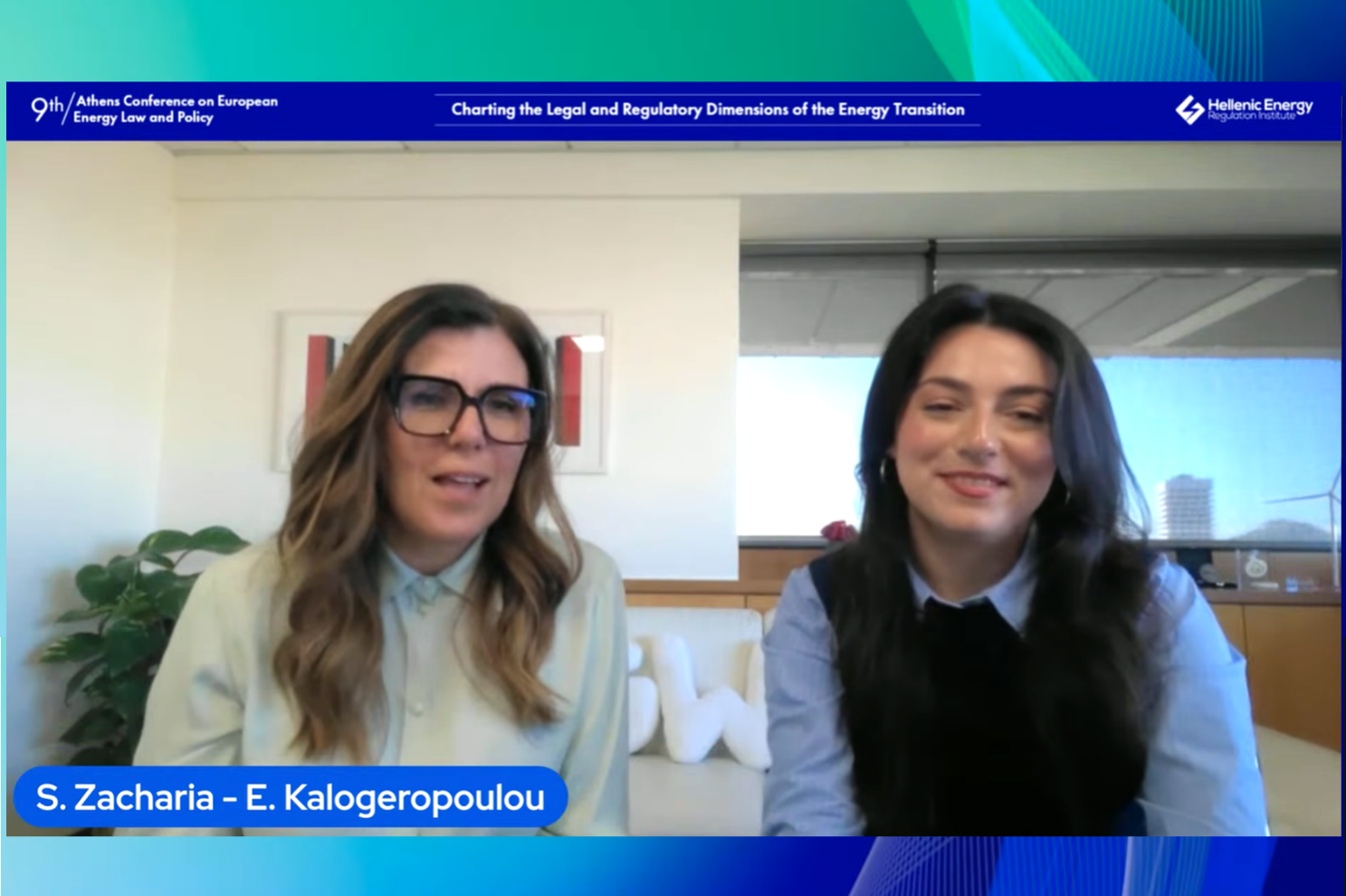
At the 9th Athens Conference on EU Energy Law & Policy, Optimus Energy delivered a deep and timely exploration of how Battery Energy Storage Systems (BESS) can unlock value in today’s rapidly evolving electricity markets. The presentation, delivered by Stella Zaharia, CEO, and Elena Kalogeropoulou, BESS Development Manager, focused on the structuring of BESS optimization contracts and the operational, commercial, and regulatory complexity behind successful storage projects
From renewable growth to system flexibility
The discussion opened with a clear picture of the structural shift taking place across all power systems. Renewable energy sources now frequently dominate electricity production, with Greece ranking among the top EU countries in solar penetration. As renewable shares increase, so do system imbalances and curtailments, with projections indicating that by the end of 2025, up to 15% of renewable generation in Greece could be curtailed.
In this new reality, flexibility becomes a system-critical resource. BESS is no longer a complementary technology, but a central enabler for integrating renewables, stabilizing markets, and managing volatility.
Why BESS optimization is fundamentally complex
A key message of the presentation was that operating a grid-scale battery is far more complex than a simple charge-and-discharge strategy. Real-world BESS operation requires continuous optimization across multiple markets: Day-Ahead, Intraday, and Balancing, each with different price signals, timelines, and constraints.
Elena Kalogeropoulou emphasized that successful optimization, especially in mature markets, highly depends on:
- High-resolution forecasting and real-time decision engines
- Automated trading and 24/7 market participation
- Sophisticated state-of-charge (SoC) management
- Continuous compliance with technical limits, warranties, and regulatory rules
As electricity markets increasingly move “by the millisecond,” batteries must be operated through advanced algorithms capable of reacting instantly to changing conditions. For this reason, Optimus Energy partnered with enspired, an internationally proven provider of dynamic optimization solutions, leveraging state-of-the-art technology to ensure the optimal market participation of energy storage assets. More information about the collaboration is available here: https://www.enspired-trading.com/bess-optimization-greece
Revenue stacking: turning volatility into opportunity
One of the core themes of the presentation was revenue stacking, or the ability of BESS to generate income from multiple market layers simultaneously. This includes energy arbitrage in wholesale markets, capacity payments from ancillary services, and activated balancing energy revenues.
However, revenue stacking is not simply about accessing many markets. It requires a single, unified optimization strategy that continuously re-evaluates market conditions, regulatory constraints, and price uncertainty. Long-term revenue predictability is inherently challenging, making advanced scenario analysis and continuous re-optimization essential.
The operating framework behind the screens
The presentation provided a rare look behind the scenes of BESS operation. From real-time asset data and VPP dispatch instructions to trading platforms, optimization engines, and customer transparency, Elena outlined how multiple systems must work seamlessly together.
The integrated framework by Optimus Energy ensures:
- Full transparency for asset owners
- Real-time visibility of performance and revenues
- Robust dispatch coordination and compliance
- Secure, reliable participation across all relevant markets
Such infrastructure is a prerequisite for scaling BESS portfolios and building investor confidence.
Performance warranties as a strategic lever
A particularly impactful part of the presentation focused on performance warranties and their direct impact on revenues. Degradation-informed optimization, which accounts for battery health and cycling limits in real time, was presented as a critical factor in maximizing long-term value.
Even small shifts in parameters such as round-trip efficiency, usable SoC, or availability can translate into millions in lost or gained revenues over a project’s lifetime. Alignment between optimization strategies, commercial contracts, and OEM warranty terms is therefore not optional, but strategic.
Choosing the right commercial model
The presentation concluded with a comparison of different BESS commercial structures, including fully merchant models, tolling agreements, and floor-and-profit-sharing arrangements. Each model reflects a different balance between risk, upside potential, and revenue stability, reinforcing that there is no one-size-fits-all solution. The optimal structure depends on the asset’s technical characteristics, the owner’s risk appetite, and market conditions.
Optimus Energy demonstrated that unlocking the full value of BESS requires far more than market access. It demands deep market expertise, advanced optimization technology, robust operational frameworks, and carefully structured contracts that align incentives across all stakeholders. As renewable-dominated grids become the norm, such integrated approaches will define the successful energy storage projects that will bloom in Greece.
In case you missed it 👉 https://www.youtube.com/watch?v=naJLSFUloz4=4020s