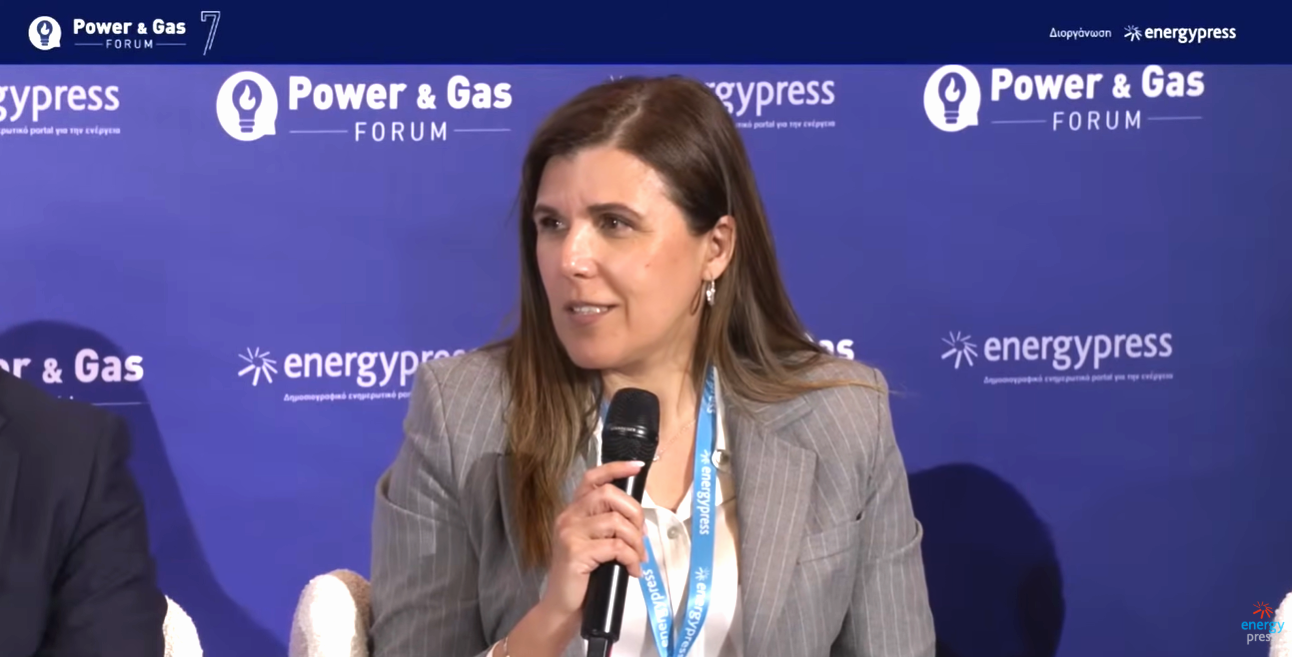
As part of her participation in the 7th Power & Gas Forum organized by Energypress, Stella Zacharia, CEO of Optimus Energy, commented on the key developments currently shaping the Greek electricity market, highlighting both the challenges and the opportunities arising from the rapid growth of renewable energy.
The Integration of Renewable Energy Brings New Challenges
The Greek electricity market has now entered a new stage of maturity. The continuous increase in installed renewable energy capacity has led to increasingly frequent periods of zero and negative electricity prices, as well as higher levels of renewable energy curtailment.
As Stella Zacharia explained, since renewable energy curtailments first emerged in 2023, installed solar capacity has grown significantly, fundamentally changing the operation of the power system. At the same time, phenomena that until recently were considered exceptional, such as negative electricity prices across European markets, are becoming increasingly common, placing considerable pressure producers, Aggregators, and system operators alike.
Aggregators Are Becoming More Critical Than Ever
Managing renewable energy portfolios has become increasingly complex. Accurate forecasting, continuous adjustment of market schedules, and the timely response to changing market conditions are now essential for reducing balancing costs and ensuring the reliable operation of the power system.
Through advanced Virtual Power Plant (VPP) energy management platforms, Optimus Energy has already integrated efficient remote-control capabilities, significantly improving the management of the renewable assets it represents while reducing the real-time operational burden on the Transmission System Operator.
Stella Zacharia also emphasized that every curtailment decision must be implemented with complete transparency, operational security, and fair treatment for all investors whose assets are represented within the company’s portfolios.
Battery Storage Represents the Next Critical Step
Particular emphasis was placed on the commissioning of Greece’s first large-scale Battery Energy Storage Systems (BESS). Optimus Energy has already completed all the necessary preparations to participate in both the Hellenic Energy Exchange and IPTO market platforms, while the first battery assets under its representation are finalizing integrations for commercial operation.
Energy storage is expected to provide the flexibility required by the power system by shifting surplus renewable generation from midday to periods of higher demand, reducing renewable energy curtailments and strengthening overall system stability.
Merchant BESS: Essential for Unlocking the Full Value of Energy Storage
During her speecg, Stella Zacharia stressed that the full value of energy storage will primarily come from merchant battery projects, which can operate with greater commercial flexibility across electricity markets.
By contrast, subsidy-supported battery projects operate within a specific regulatory framework that partially limits the commercial utilization of their available capacity. For this reason, accelerating the licensing and deployment of merchant storage projects is a critical step for the continued evolution of the Greek electricity market.
She further highlighted that regulatory authorities and all relevant stakeholders should prioritize the rapid advancement of merchant battery projects, enabling more of these assets to enter the power system as soon as possible and contribute meaningfully to improving system flexibility, reducing renewable energy curtailments, and enhancing the overall efficiency of electricity markets.
Optimization Across All Markets Maximizes Investment Value
The effective operation of a battery is not limited to participation in the Day-Ahead Market alone. As Stella Zacharia explained, the true economic value of a battery investment is unlocked when optimization is performed simultaneously across all available electricity markets, including the Day-Ahead Market, Intraday Market segments, and Balancing Market.
Continuously updating operating schedules, making real-time trading decisions, leveraging algorithmic optimization models, and providing ancillary services can significantly enhance both the revenues and overall performance of battery storage investments.
Technology and Expertise Are the Competitive Advantage
Managing a modern battery portfolio requires advanced technological infrastructure, continuous market monitoring, and a high level of operational readiness.
For this reason, Optimus Energy has invested in state-of-the-art optimization tools and strategic partnerships with leading European technology providers, aiming to maximize the value of the assets it represents while delivering best-in-class services to investors.
At the same time, the successful development of the energy storage market requires close cooperation among all stakeholders, including investors, market representatives, system and market operators, and authorities, to ensure that battery storage assets gain full access to all electricity markets and can deliver their full value.
Modern Energy Management Is a Strategic Competitive Advantage
Stella Zacharia also highlighted the increasingly critical role of energy management in today’s electricity markets. As renewable generation and energy storage continue to expand, the effective representation of such portfolios extends far beyond submitting market schedules; it now requires continuous risk management and real-time optimization.
As she pointed out, Aggregators are now required to make hundreds of decisions every day while simultaneously managing participation in the Day-Ahead, Intraday, and Balancing Markets, with the objective of maximizing portfolio value while minimizing exposure to imbalances and charges.
Achieving this requires the use of advanced technologies such as optimization platforms, algorithmic trading, artificial intelligence, real-time forecasting systems, and Virtual Power Plants (VPPs), which have become an integral part of modern energy companies.
Particularly for Battery Energy Storage Systems (BESS), she stressed that the financial performance of an investment depends not only on the equipment itself but also on the quality of commercial optimization and energy management. The ability to participate across all electricity markets and make real-time optimization decisions can substantially increase both the value and the revenues of a storage project.
A New Era for the Greek Electricity Market
Concluding her remarks, Stella Zacharia noted that Greece is entering a defining new chapter in its energy transition. The continued growth of renewable energy, combined with the deployment of battery storage, digitalization, and advanced optimization technologies, is laying the foundations for a more flexible, efficient, and resilient electricity system.
Optimus Energy remains committed to investing in technology, innovation, and people, actively contributing to the development of the next generation of Greek and European electricity markets.